From time to time I happen to be invited to talk/present/lecture at various seminars and conferences. Not that I’m too smart or anything, but there’s simply not so many people and companies that are genuinely paying attention or investing into modern HR practice and CSR.
These invitations include guest lecturers at Universities, student seminars, and once I was even trying to explain CSR to a bunch of not-so-keen-to-learn SME people.
This time, though, I was invited to (together with a colleague of mine) think about a 90 minutes workshop for 40 high-school teachers from 20 European countries (well, in the end there were 20 from 10 countries, but anyways…). Now that’s a challenge – how and what do you teach people that make their living by teaching? Sure, we’re in the same field of work – education – but we doubted that our approaches and way of thinking are anywhere similar. Nevertheless, we wanted to give our best to make this time useful for them, so we decided to try to challenge their views and give them some space to think and talk about the future of education in high schools.
Name of the workshop was “Creativity and Innovation” and we started it with a 20 minutes presentation about the world enormous growth in last 200 years, how everything changed (ways we communicate, cars we drive, shops being online today etc) except how classrooms look like (they look almost exactly the same in last 100 years, if not longer). We also added a few slides about modern technology (Kindle, audio books, social media etc), then about the switch between Generations Y and C (Gen C – born after 1990 – connected, communicating, content-centric, computerized, community-oriented, always clicking), and finally we gave them a food for thought before splitting into working groups – a paradigm shift:
–1990 – we are using knowledge
–2000 – we are involved in learning
–2010 – we are creating the knowledge together.
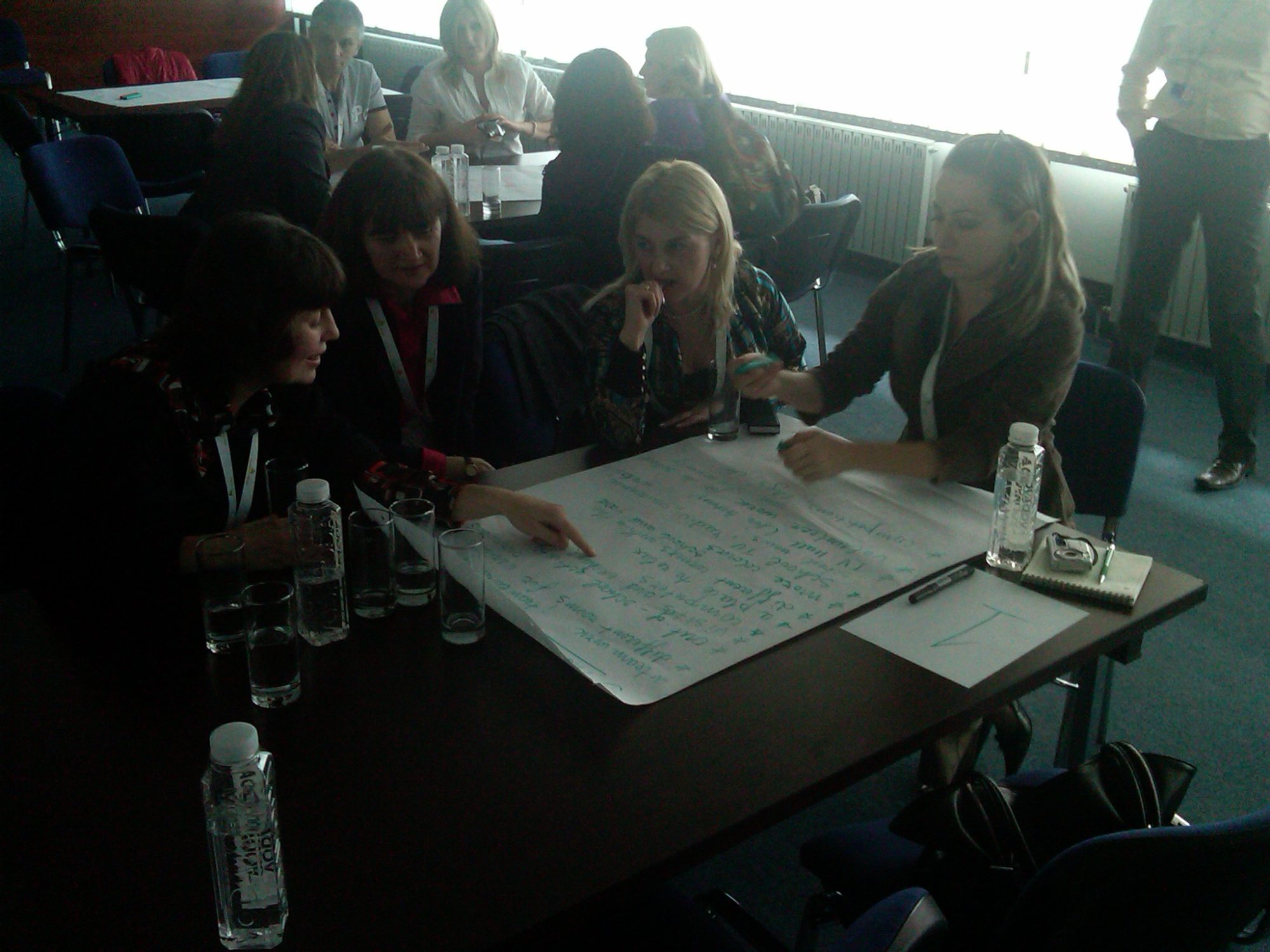
This provocation kinda worked and this cool group was eager to discuss openly situation in their countries (Georgia, Turkey, Lithuania, Bulgaria, Austria, Israel, Macedonia, Serbia…) and give ideas and good case practices to be worked on towards creating a better school in the future. After some 45 minutes (how convenient) of rotations on these topics, the results are 3 flipcharts with a lot of cool stuff on them. And this is how, based on these teachers, the schools should look like in the future:
Environment (how classrooms should look like, seating arrangements, space for leisure, school appearance, the appearance of the school yard etc)
teamwork, different rooms for various purposes, out of school activities, visits and exchanges (business), computers with internet, a place to relax, more colours, school tv, radio, newspapers, website, tv hall (for lectures), volunteer work for the school and community, competitions, blogs etc.
Teaching / knowledge transfer methods
analyze the needs (what and how do they want to learn?), analyze types of learners (most lectures are auditive, while visual people are ignored…), encourage especially those that are motivated, create a link between student and teacher, teacher must be leader/facilitator/guide, technology and social media should be used more, students should be taught how to learn and to be motivated to search for more knowledge, exchange programs should be encouraged (especially intercultural ones), e-learning as a support to traditional methods
How to support/facilitate effective communication (teacher – student and student – student)
teacher needs to be a mentor, permanent access (e-mail, facebook, chat), there should be no fear, active learning through interactive methods, teacher should be a marketing manager – sell his product, trust is crucial, groupwork.
As you can see, there are cool ideas and there are awesome ideas. On the other side, some of those ideas are already in place in many schools in the western world and some are really easy to be implemented. But I honestly did not hear many inspirational and visionary ideas, not at all. Instead, they were listing basically what they hear in the news, on seminars they visit from time to time, or what ministries in their countries keep promising before every elections.
Except for one really big idea: “Let students create schools they will enroll”
Now that’s what I call an idea! A bold, visionary idea that could change everything. Ask the end users how they want to be served with products. Evolve.
Even in the presentation before the workshop, we used slides and ideas from visionaries such are
Thomas W. Malone (
The Future of Work) and
Marcus Orlovsky (
Bryanston Square Consulting), people that are already trying to change things (especially the latter) and I’m really happy that these high-school teachers had enough capacity to come up with such a big idea. I mean, regardless of the development of our countries, we all know that education/school systems are the hardest to be changed. Just look at Bologna system and how slow the implementation is…
So, the challenge now is to figure out what to do with this. I know I will share the results with the participants and the organization that brought them together –
Junior Achievement, as well as with Mr. Orlovsky that is trying to do something similar in the UK. But what else can we do? What else can we tell them and encourage them to do?
Is there anyone out there that shares this idea that schools should be completely redesigned to support creativity and innovation and most importantly designed by students themselves? How should that look like?
Please, do share your thoughts…
Pingback:Nikola Jovanovic
Pingback:Tweets that mention Teaching the teachers - School of the future | PećkoPivo -- Topsy.com
Nikola, do share some flip-charts so we can have cool stuff to discuss about 🙂 this way I can only AGREE with everything you said (which is not enough)
Pingback:Nikola Jovanovic
Pingback:Nikola Jovanovic
Pingback:Dragana Markovic
Pingback:Classroom Supply
@Jelena – those 3 bolded “headlines” are the flipcharts I’m mentioning 🙂
As I said, not much – more like using common sense… But still, it would be worth doing it even if only the “big idea” popped up.
And this proved to myself that initiating a dialog with teachers is actually possible. Even if Serbian part of the group was quite “relaxed” and had no issues with picking up a call in the middle of conversation etc :), they were still quite active and objective when it comes to their work and the system they work in…
Pingback:YokoUma
Pingback:Dragan Radović
Pingback:Aleksandar Miletic
Intro course to schools and creativity:http://www.ted.com/talks/lang/eng/ken_robinson_sa…
All of the other links available on youtube from Sir Ken Robinson should also be quite interesting for anyone keen on the topic. Sir Robinson has been working or reorganizing the education system for over 20 years and is one of the most diligent critics of the today’s educational systems worldwide
I will give you only some minor points that I agree on with Sir Robins and many other that Nino already mentioned in the text:
1.Representational systems – you are most probably aware that we use 5 senses to create our representations of the world (similar to what neuroscientists would call qualia). These are visual, auditory, kinesthetic (touch, emotions, balance, pain), gustatory (taste) and olfactory (smell). Out of the five, people rely on the first three much more than the taste and smell. Tests so far indicate that each one of us usually has one primary system that she/he prefers to others, moreover most people use primary and a secondary system in their communication and learning. For example, my primary system is Kinesthetic and my secondary system is Auditory. This implies that a preferred way of learning for me is to Feel (try out, test, pilot, do a case study) and then Hear (listen, talk about a topic) NOT visual (PowerPoints, other slides and overheads, charts and tables etc).
Now, if we consider that, according to research that I have access to, about 50% of the people are primarily VISUAL, about 40% are kinesthetic and only about 10% are Auditory (it also explains why most of the people are concerned about their looks and appeal, and their feelings, and most of the time do not listen to other people. We think that if I see you there is no reason to listen to you. )
Now, if you allow me to take you back to high school and remember what was going on during the classes you will surely remember the endless talks and lectures our teachers delivered. That’s nice – it covers about 10% of the people who are Auditory. Some of the most ingenious teachers we had even used some pictures and slides, maybe a chart or some maps. That’s also nice but it does not happen that often – now we have about 50% of students who are visual and 10% who are auditory stimulated at least to some extent.
That leaves us with just about 40% of the students who need to try stuff out, experiment, touch, and pilot and learn while doing. But we don’t care. And to the best of my memory those visual and auditory people were not very stimulated by the lectures to begin with. How should the kinesthetic feel to have their needs completely ignored?
2.We have a whole set of illness or disorders that we can pin to students that do not comply with the manner of teaching and discipline. If a child in the primary school does not behave as the teacher wants or learns at the pace and method the teacher claims is the best than the child is either stupid or ill. God forbid that there is something wrong with their teaching methods!
Albert Einstein had ADD (Attention Deficit Disorder commonly treated with a drug called Ritalin), however he was quite lucky that we did not know about ADD back in his time, so we just called him CRAZY. If he was in school today, he would have been prescribed Ritalin, a drug that makes little children sit down, behave and smile. There have been NO studies, or at least I have not seen one, about the effects of drugs such as Retilin on children’s creativity, but I am betting money that the effect would not be enhanced creativity.
3.Lastly for this text: Who is responsible for the proper communication and knowledge transfer? The teacher (The sender of the message, the initiator of communication, the expert in the field?) or the student (The Learner)? For anyone who has at least some basic knowledge of communication it is clear the responsibility for the message transfer is on the Sender, the Teacher, the Initiator. Why then I constantly hear that the children today are not willing to learn, to develop, to expand their skills and knowledge? Wait a minute: whose job is it to motivate them to learn, to get them eager about knowledge and the world? The professor’s? Hmmm? Someone is not doing their job I guess!
These are only some short points that came to mind first. This discussion is never over, is it? Unfortunately it has not been resolved in any country in the world. Education system is one of the most inert systems I have ever encountered. It is dominated with professors who do not feel a need to change or improve. Why should they? It’s the student’s fault anyways. We professors are teaching them the same way we did for decades; it is those ungrateful, pot smoking, uninterested students that are to blame!
that's my 5 cents for this topic 😀
——————
Ko drzi ovaj svet? PIONIRI!
A vi, Nemate pojma!
Pingback:uberVU - social comments
Pingback:Dusan Basalo
Pingback:Nikola Jovanovic
Pingback:“Building Schools for the Future” – Marcus Orlovsky | Dragana Marković